

Knowledge base › Survey guide
Survey guide
CEE VIEWS – Why Single Beam Echo Sounders Continue to have a Place Alongside Multibeam
Often not. Multibeam is the right tool for large areas, deep water and permanent installations such as port wharf checks, but for small, remote or shallow water surveys a dual channel single beam echo sounder is cheaper, far more portable and quicker to deploy. In shallow water the multibeam swathe narrows so much that its coverage advantage largely disappears.
30 min to install a single beam on most boats
2 channels for sub-bottom information
<40m typical navigation survey depth
95% multibeam coverage at a 60° swathe
CEE HydroSystems doesn’t make multibeam echo sounders. For many survey types the multibeam has rightly become the instrument of choice, but it is very unlikely to replace single beam methods for small area, remote or shallow water surveys. Always choose the right tool for the job.
What’s the difference between single beam and multibeam?
A single beam echo sounder (SBES) transmits one beam straight down to the seabed and waits for the echo. The time between ping and echo is directly related to the water depth, so the technique is simple and robust. Many survey-quality single beam echo sounders have two channels on very different frequencies, which penetrate the water and bottom sediments differently.
A multibeam echo sounder system (MBES) transmits a fan of pings to cover a swathe of seabed in one pass. It is a complicated technique that needs careful equipment set-up, calibration and monitoring.
Covering a swathe in one pass, instead of several single beam passes, is a clear benefit. But in real hydrographic surveying other factors come into play.
What does each tell me about the seabed?
A modern single beam echo sounder gives the depth plus information about what is in the water column. A dual channel single beam gives the depth to the top of the seabed, plus echoes from pings that penetrate into it: an acoustic picture of the seabed layers.
- A hard bottom gives the same depth on both channels.
- Silt over a hard base (such as rock) gives two distinct depths, with a lot of information about the bottom around them. There are many variations: silt over compacted clay, silt over fine or coarse sand.
This isn’t an exact science, as much depends on the bottom. A multibeam gives the depth to the top of whatever is on the seabed. See what is an echogram for how the two channels are read.
What does a multibeam really cost?
Single beam echo sounders and transducers are much cheaper than multibeam systems, and much easier to install. Outboard mounts on “vessels of opportunity” (local rental boats) are easy. A multibeam also needs:
- several costly peripheral instruments;
- personnel training;
- costs that are often forgotten: transport, and re-installation every time you change vessel.
Do I need full bottom coverage?
For many surveys, no. Area and volume / capacity calculations don’t need total coverage: a sensible single beam line spacing gives much the same result, and more importantly shows where sediment is building up.
In shallow water the multibeam advantage fades. Swathe width is proportional to depth, so as the water gets shallower the lines have to get closer together for full coverage. Eventually full coverage becomes impossible and the multibeam’s benefits are essentially gone.
What about navigation surveys?
Navigation surveys are generally in water less than 40 m deep and need as close to total coverage as possible. Multibeam is the instrument of choice here, but a single beam approach can still make sense. The IHO accepts that a single beam echo sounder run together with a side scan sonar (SSS) can achieve similar results to multibeam.
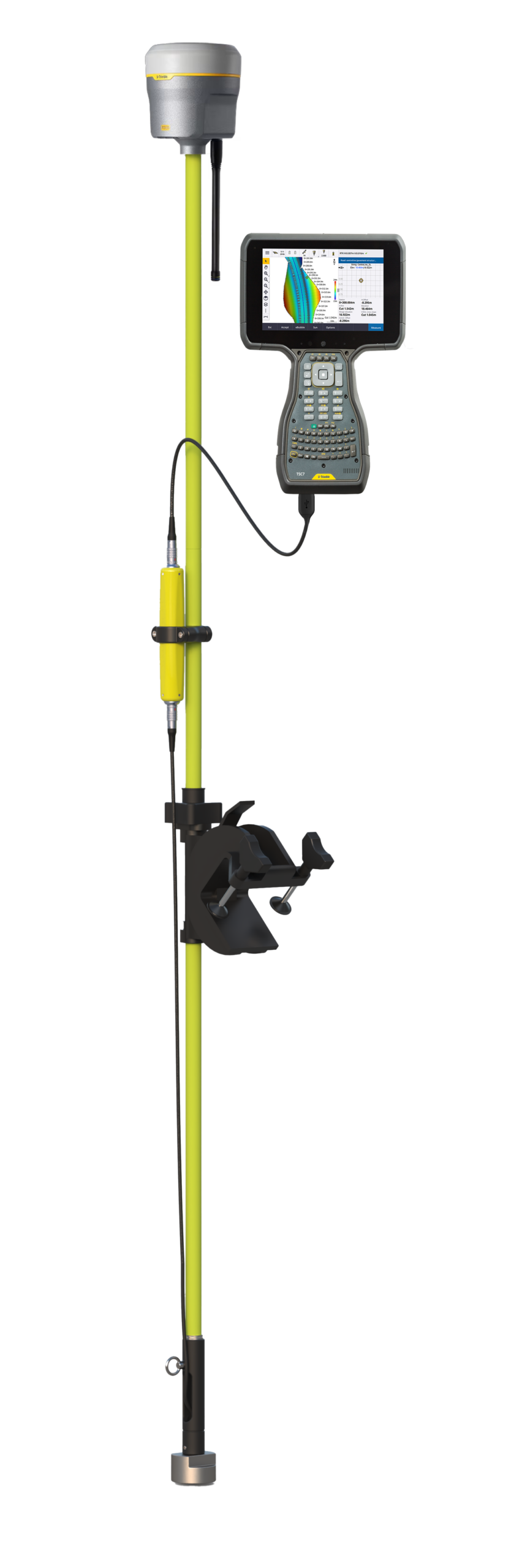
- Mount the echo sounder transducer, the SSS towfish and the positioning antenna on the same support pipe, with no offsets.
- Set the line spacing so the side scan covers the area between lines.
- Investigate any seabed features the side scan finds with closer line spacing.
Time on site may be longer than with a multibeam, but the extra boat hire, accommodation and labour can still cost less than buying, maintaining, freighting and installing a multibeam.
How do they compare?
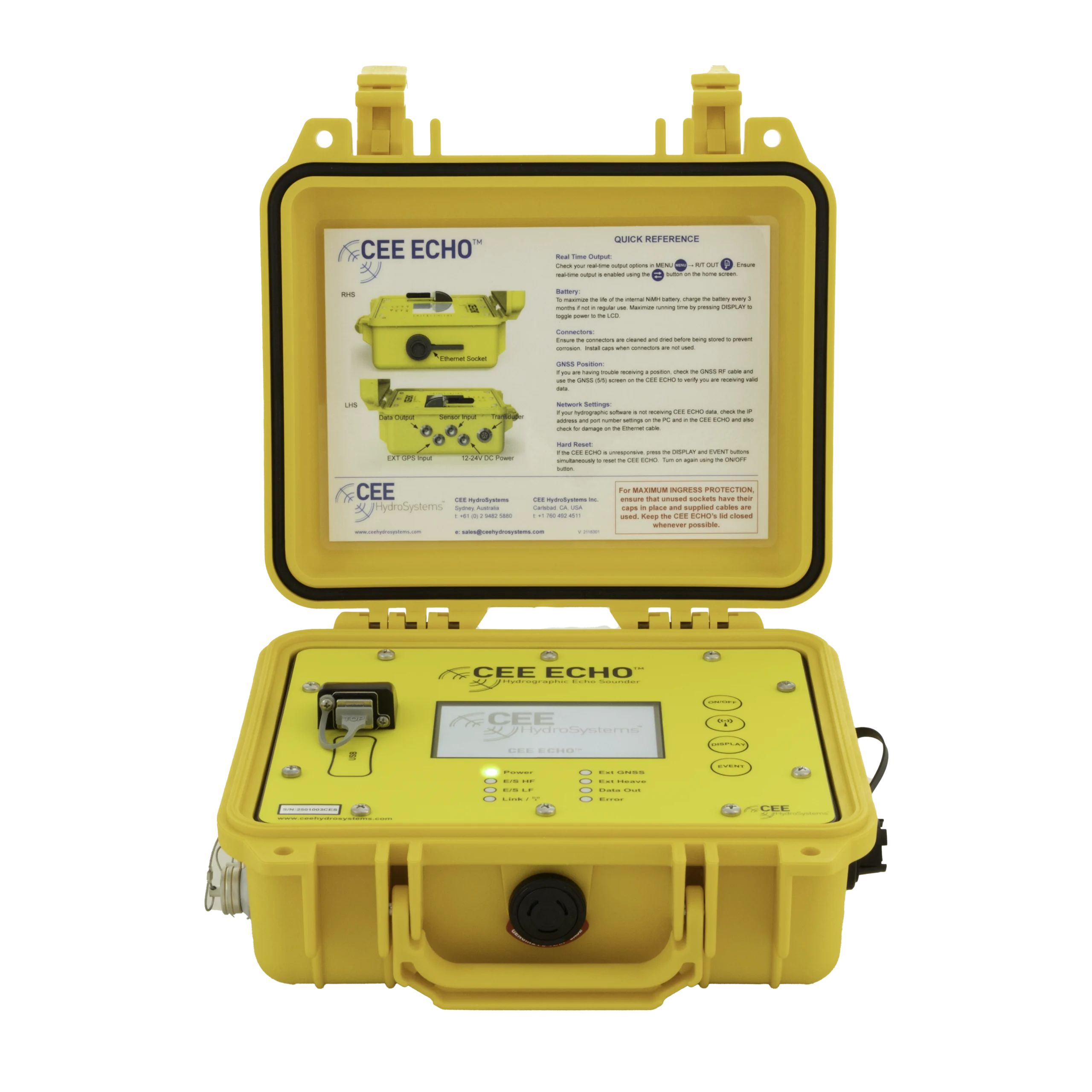
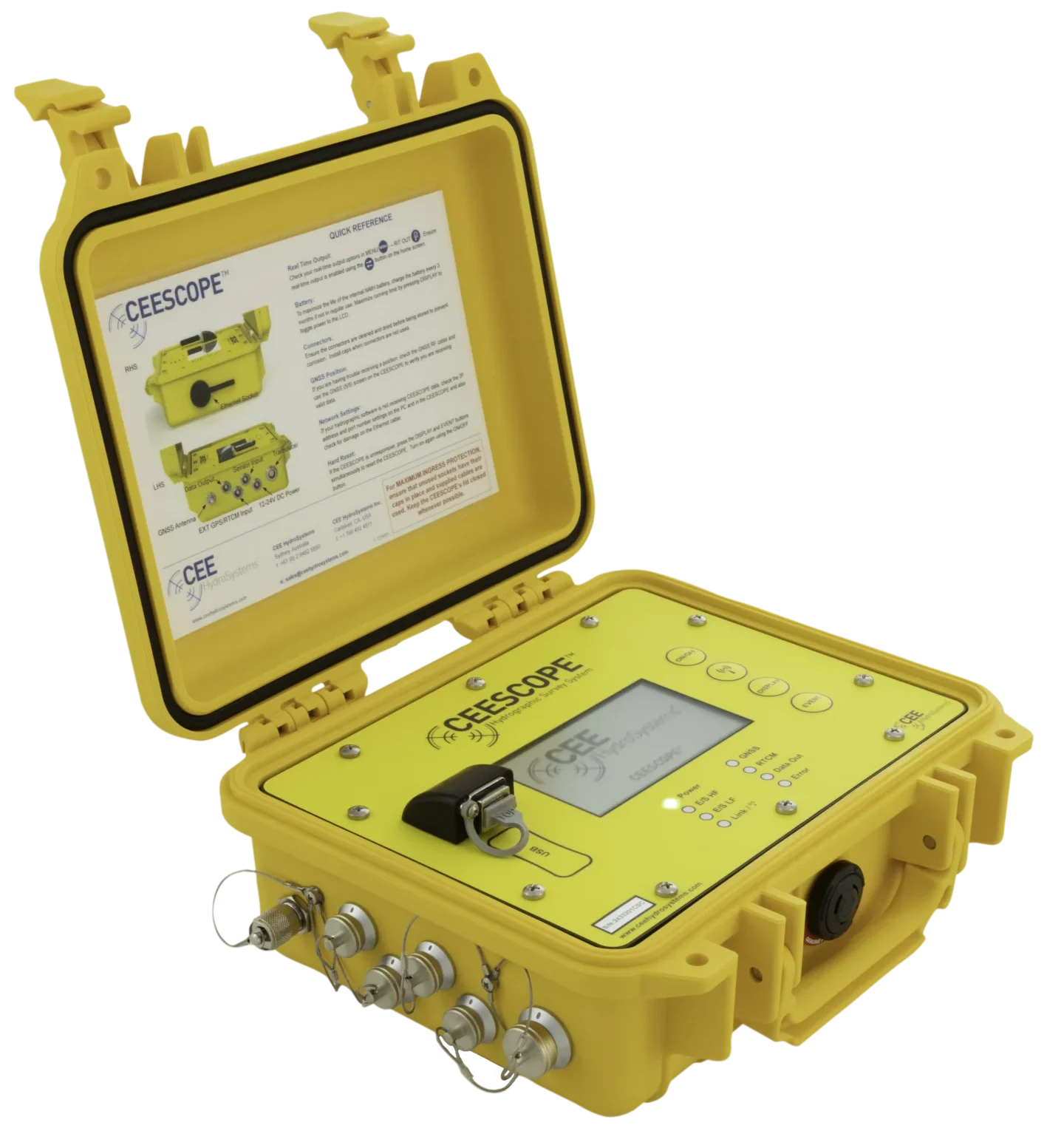
| Factor | Single beam, dual channel (CEESCOPE™ with RTK GNSS) | Multibeam |
|---|---|---|
| Instrument cost | Moderate | High |
| Transducer cost (dual) | Low | High |
| Transducer mount fittings | Low, nominal | High |
| Software cost | Moderate | High |
| Acoustic velocity meter(s) | Moderate | High |
| Heading device | Not required | High |
| Heave / motion device | Optional, not included | High |
| Effective seabed coverage | Side scan option | 95% at a 60° swathe |
| Water column information | Yes | Yes |
| Sub-bottom information | Yes | No |
| Ease of use | Easy, intuitive | Difficult |
| Portability | Excellent | Moderate or poor |
| Installation | Very simple | Involved, expensive |
| Calibration | Very simple | Involved |
| Maintenance | Minimal | Expensive |
| Personnel training | Minimal | Expensive, very involved |
When is a multibeam worth it?
- Permanent installations, where the same vessel works the same area week after week. A typical example is a busy port checking a wharf for obstructions before a vessel berths: multibeam is quick and effective.
- Large areas, because installation and calibration take about the same time whether the area is 100 × 100 m or 100,000 × 100,000 m.
In small areas, a single beam can be deployed and the survey finished before a multibeam has even been unpacked.
So which should I buy?
It depends on your business. A survey contractor who flies to jobs and often uses a local vessel of opportunity would need a major project to justify a multibeam. A single beam system can travel as accompanied baggage and be installed on most vessels in 30 minutes. Closer line spacing adds acquisition time, but that is likely to cost far less than running a multibeam. If you work offshore on large projects, a multibeam will quickly pay for itself.
One last word: with the right software, multibeam data makes beautiful 3D pictures of underwater topography. They may not be exactly accurate, but they look great. You can make beautiful 3D pictures from single beam data too.
Equipment used
Talk to US
Need a hand with your set-up?
Our engineers answer survey questions every day.